Can you lease a car with bad credit?
Yes, but fewer people do it than you might think, and the deal looks different. A lease is still credit: the leasing company owns the car and trusts you to make every payment for two or three years. When your credit history is rough, the lender does not always say no. It says "yes, if" — and the "if" costs money.
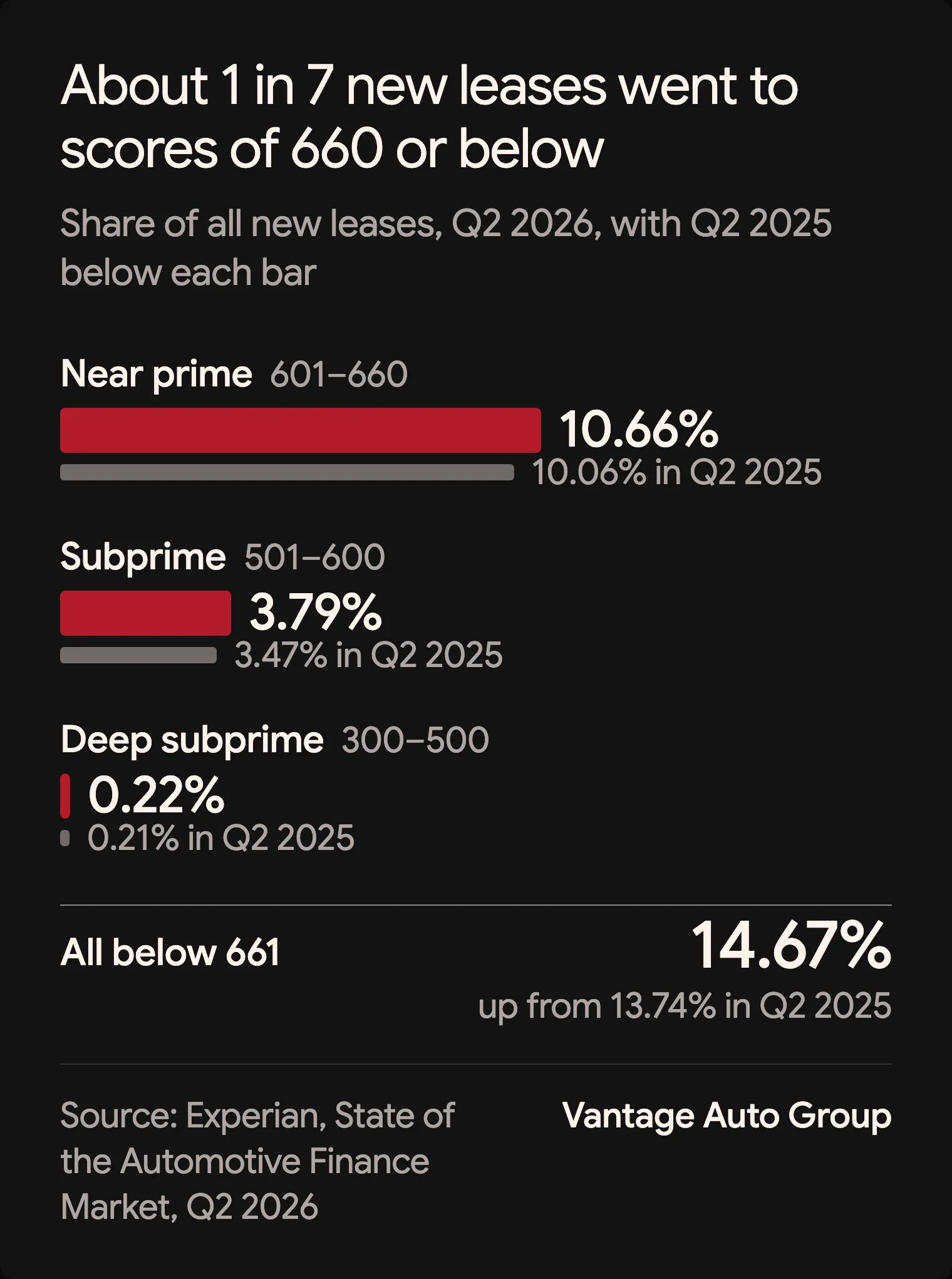
Here is the part of the market this article is about: the share of all new leases in the second quarter of 2026 that went to scores below 661, using Experian's risk tiers (VantageScore 4.0), with the year before for comparison:
| Credit tier (below 661) | Score range | Share of all new leases, Q2 2026 | Q2 2025 |
|---|---|---|---|
| Near prime | 601–660 | 10.66% | 10.06% |
| Subprime | 501–600 | 3.79% | 3.47% |
| Deep subprime | 300–500 | 0.22% | 0.21% |
| All below 661 | 300–660 | 14.67% | 13.74% |
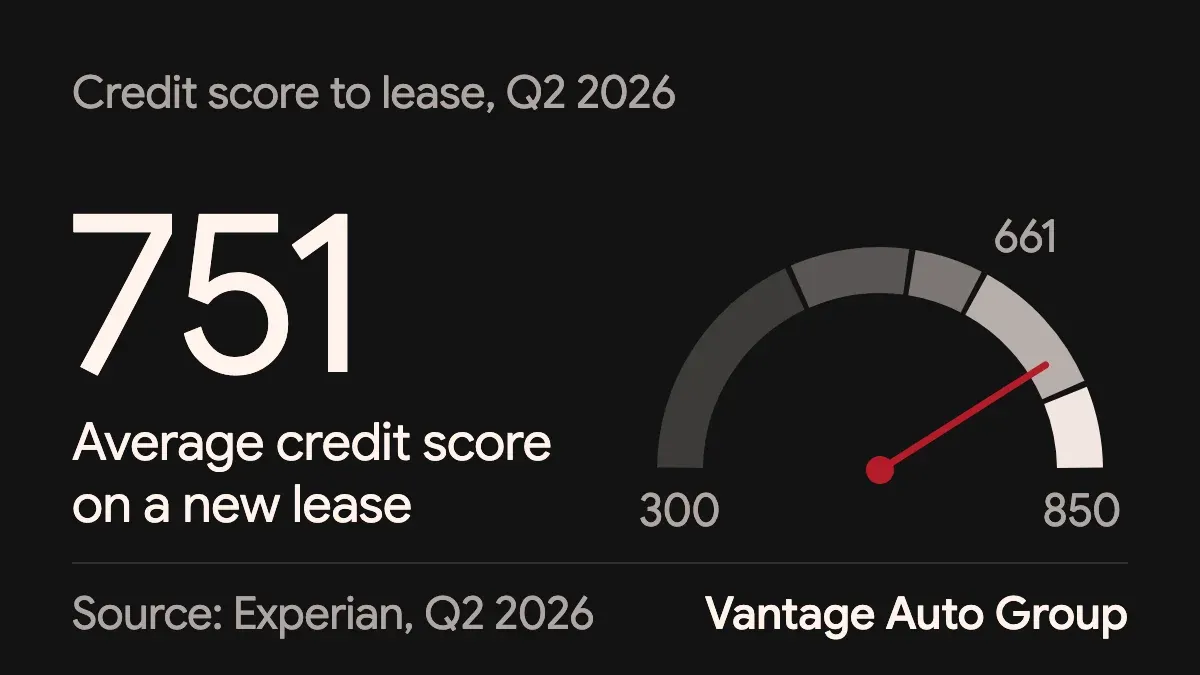
Source: Experian, State of the Automotive Finance Market Q2 2026 (slides 3 and 22). The average new-lease score that quarter was 751, down from 753 a year earlier, and the near-prime and subprime shares both grew. For all five tiers, including prime and super prime, see what credit score you need to lease a car.
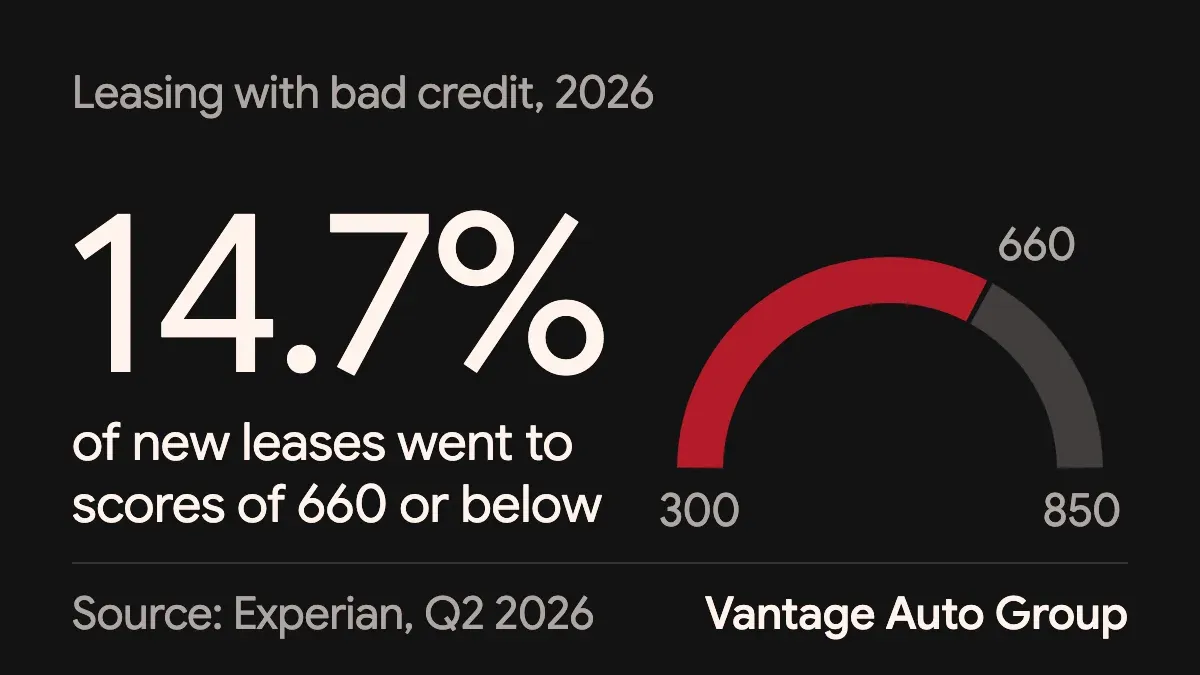
Two honest takeaways. First, roughly 85% of new leases go to prime and super-prime customers, so lease programs are built around strong credit. Second, about 15%, roughly one lease in seven, went to scores of 660 or below. Bad-credit leases are uncommon, not impossible.
One caution: Experian's tiers use VantageScore. Many auto lenders pull a FICO Auto Score instead, so the number you see in a free app may not match what the lender sees. There is no single published "minimum score to lease." Each lender sets its own tiers, and they change.
Want real numbers on your next car?
Tell us what you're looking for and we'll source your options across 350+ dealer partners. There's no obligation. Or see current New Jersey lease deals.
What changes when you lease with bad credit
The car is the same. The terms are not. When a lender places you in a lower credit tier, these are the levers it pulls:
| What changes | What it means for you |
|---|---|
| Higher money factor | The money factor sets the rent charge, the lease's cost of money. Lower tiers get a higher one, which raises your monthly payment (money factor explained). |
| More due at signing | The lender may want a bigger initial payment so it has less at risk. That lowers the monthly payment but money paid up front is gone if the car is totaled or stolen early. |
| Security deposit | Some lenders ask for a refundable deposit on lower-tier approvals. Ask whether it is refundable and when. |
| Co-signer | A co-signer with stronger credit can move the application into an approvable tier. They take on real legal risk (more on that below). |
| Fewer programs | Advertised lease specials usually assume top-tier credit. With bad credit you may only qualify for the lender's standard rate, or only with certain lenders. |
| Proof of income | Expect requests for pay stubs, bank statements or tax returns. Stable income and a payment that fits your budget matter more when your score is low. |
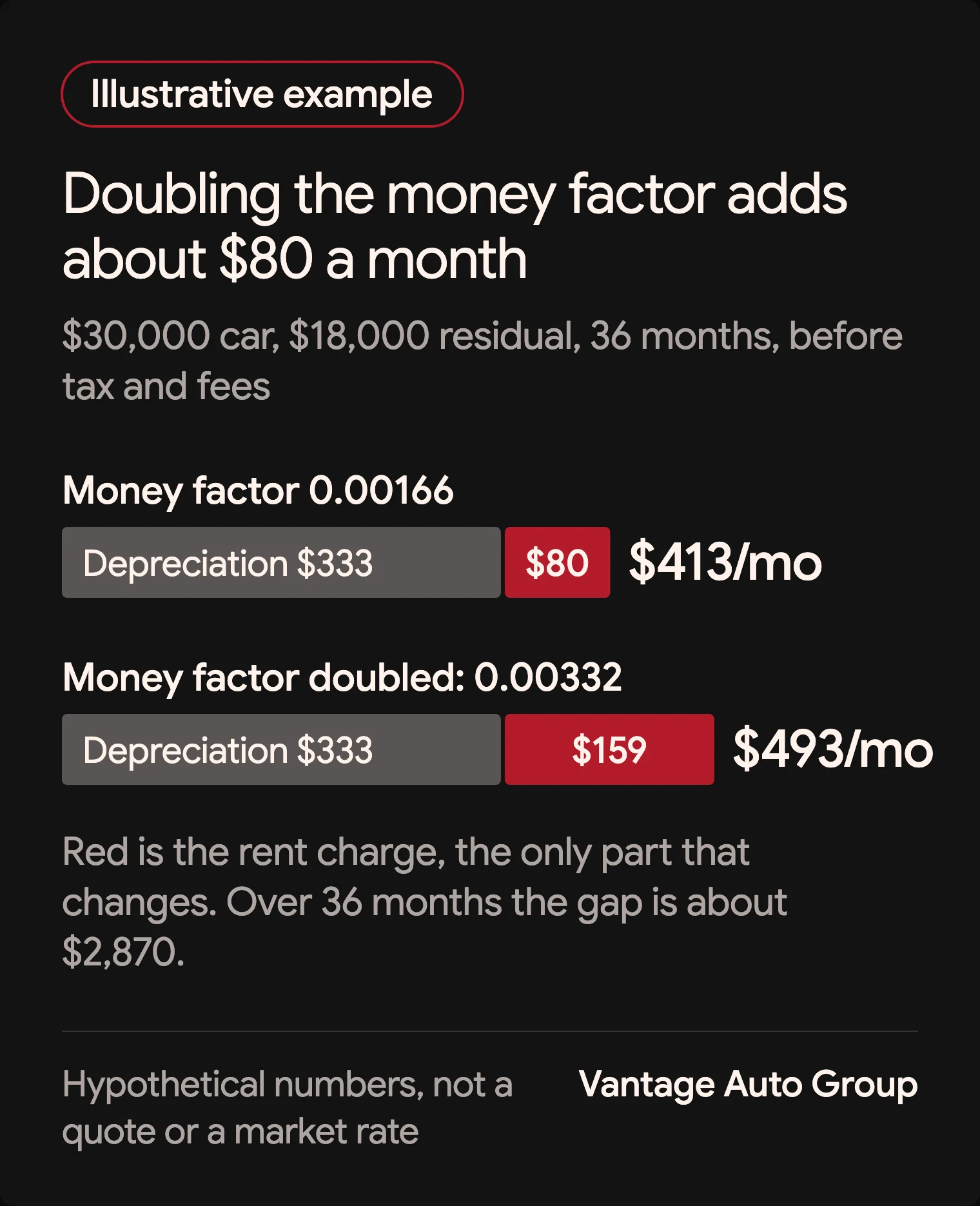
The money factor is the change you feel every month. Here is how much it can move the payment on the same car, using made-up numbers:
| Illustrative example (hypothetical) | Lower money factor | Money factor doubled |
|---|---|---|
| Price (capitalized cost) | $30,000 | $30,000 |
| Residual value | $18,000 | $18,000 |
| Term | 36 months | 36 months |
| Money factor | 0.00166 | Doubled: 0.00332 |
| Depreciation per month: ($30,000 − $18,000) ÷ 36 | $333 | $333 |
| Rent charge per month: ($30,000 + $18,000) × money factor | $80 | $159 |
| Monthly payment, before tax and fees | about $413 | about $493 |
What is the easiest car to lease with bad credit?
There is no magic list. The easiest car to lease with bad credit is the one where three things line up: a lower total price, a payment that is small compared to your income, and a lender whose current program reaches your credit tier. Lists of "bad credit cars" online are usually guesses, because lender tier rules change month to month and are not published as a public table.
What actually makes one car easier to get approved for than another:
- A lower price. A smaller amount being leased means a smaller payment and less risk for the lender. A well-equipped compact is usually an easier yes than a loaded SUV.
- A strong residual value. Cars expected to hold their value have lower lease payments, which helps your payment-to-income math.
- A lender with flexible tiers right now. Each brand's leasing arm (the "captive lender") and each bank sets its own credit tiers. Some reach further down the credit range than others, and that changes with sales goals and the time of year.
- A shorter term. A shorter lease can be easier for some lenders to approve, though the monthly payment is usually higher.
Mainstream, high-volume models from non-luxury brands tend to be the realistic starting point, simply because they cost less. Luxury brands are not off the table, but their higher prices make the payment-to-income math harder. Which brands are reaching lower credit tiers changes with each lender's current programs, so check this month's programs rather than a list from last year.
"Easiest car to lease with bad credit, no deposit" — is that real?
Be realistic. Lower credit tiers usually come with more money up front, not less. A lender that is stretching to approve you has every reason to ask for a deposit or a larger initial payment. If an ad promises bad-credit leasing with nothing due at signing, read the fine print. The FTC says dealers that promote special prices must clearly explain what's required to qualify for them.
How to lease a car with bad credit: 6 practical steps
- Pull your credit reports first. You can check your reports from Equifax, Experian and TransUnion for free every week at AnnualCreditReport.com, per the FTC. Dispute any errors before you apply, and give corrections time to update.
- Set a real budget. Decide on a monthly payment and an amount due at signing you can actually afford. A lease you can't keep up with hurts your credit further.
- Pick the car to fit the credit, not the other way around. Start with lower-priced vehicles that meet your needs. You can step up later once your credit improves.
- Line up a co-signer, carefully. A co-signer can help, but the CFPB warns a co-signer is legally obligated to repay if you can't, and late payments can hit both credit reports. Only ask someone who fully understands that.
- Keep your applications in a short window. FICO generally scores multiple auto credit inquiries within a short window as one, but the window can be 14 or 45 days depending on the score version, so myFICO and Experian suggest keeping shopping tight. Don't spread applications across months.
- Consider a lease takeover. Taking over someone else's lease can mean a shorter commitment, but Experian notes the leasing company still checks your credit and typically wants a profile similar to or better than the original lessee's. Vantage Auto Group can help match you with a driver looking to hand off a lease and coordinate the transfer with the leasing company and the licensed dealership.
Before you apply: a quick checklist
- Your three credit reports, checkedPulled free at AnnualCreditReport.com, errors disputed, and about 30 days allowed for corrections to update.
- Which score the lender usesMany auto lenders pull a FICO Auto Score, so the number in your app may not match theirs.
- A budget for both numbersThe monthly payment and the amount due at signing, each one you can actually afford.
- Proof of income, ready to sendRecent pay stubs, bank statements or tax returns.
- A co-signer who understands the risk, if you need oneThey are legally obligated to repay if you can't.
- A short shopping windowKeep credit applications within 14 days to be safe. Some scoring versions allow 45.
- Your questions for the dealThe money factor, capitalized cost, residual and every dollar due at signing.
Not sure where your credit lands? Tell us the car and your budget, and a Vantage lease specialist will walk you through which dealer-partner programs may be worth trying. Request a Quote — no obligation.
Red flags when you have bad credit
People with credit problems are the main target for bad deals. Watch for these:
- Ads that promise approval to everyone. The FTC says legitimate lenders won't promise you credit before you apply and before they know your credit history. Treat any guarantee as a sales line.
- Fees to "unlock" an approval. Per the same FTC guidance, an up-front fee demanded before you get an offer is a cue to walk away.
- Being steered to buy-here-pay-here. Buy-here-pay-here lots sell used cars and lend the money themselves. A CFPB study found average rates of roughly 15% to 20% at finance companies and buy-here-pay-here dealers, versus about 10% at banks, for subprime borrowers, along with higher default rates.
- Only being shown a monthly payment. Ask for the money factor, the capitalized cost, the residual and every dollar due at signing. A low payment can hide a large amount up front or a marked-up money factor.
- Driving off before the deal is final. The FTC advises getting a signed copy of the completed lease agreement before you leave the dealership.
Where can I lease a car with bad credit?
Leases are written through franchised dealerships, using the brand's own leasing arm or a bank the dealership works with. That is the key point: a single dealership can only submit you to the lenders it works with. If those lenders say no, that dealer's answer is no, even if a different lender might have said yes.
That is where a broker helps. Vantage Auto Group is a licensed New Jersey auto broker, and we work through our dealer-partner network. We don't lend money or make credit decisions. What we do is look at your situation, identify which dealer-partner lease programs may fit your credit profile, and show you every number before you sit down to sign. The licensed dealership and its lenders make the approval decision, and all terms are subject to credit approval.
In practice, that means:
- We review your situation and point you toward programs that may be a realistic fit, instead of guessing at one dealership.
- We check which brands' current lease programs are reaching lower credit tiers this month.
- We assist in negotiating with our dealer-partner network and show you the money factor, initial payment and total cost up front.
- We tell you straight if waiting a few months to clean up your credit would likely get you a better deal.
Whether your score is 580 or 680, the approach is the same: right car, right program, a deal built around your budget.
Leasing vs. buying with bad credit
Lease payments are generally lower than loan payments on the same new car. In Experian's Q2 2026 data, lease payments averaged $148 a month less than loan payments across leased models. A lower payment can help your payment-to-income ratio, which some lenders weigh heavily.
But leasing isn't automatically the easier path. Lease programs skew heavily toward strong credit, as the Experian figures above show, and a lease ends with nothing to keep unless you buy the car out. If your credit is in the deep-subprime range, rebuilding for six to twelve months may lower your cost more than any car choice will.
The bottom line
You can lease a car with bad credit, but expect to pay more and to have fewer choices. Choose a lower-priced car, bring proof of income, budget for more due at signing, and stay away from anyone who promises approval before you apply. If you want help seeing which dealer-partner programs may fit before you apply, talk to a lease specialist or browse current New Jersey lease deals.
Related: What credit score do you need to lease a car in 2026?